
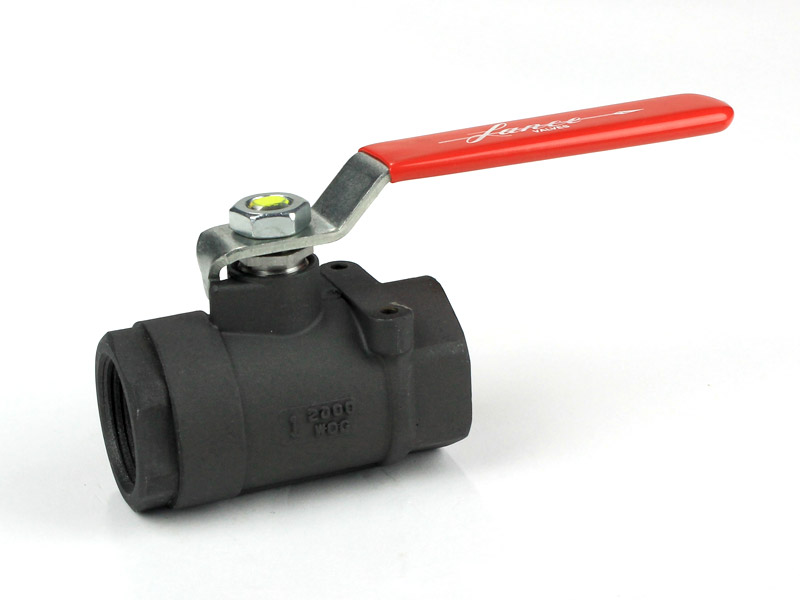
23 Series-Carbon Steel Steam Service
23 Series
2000 PSI Ball Valves, Carbon Steel
Lance 23 Series 2 piece 2000 PSI carbon steel ball valves are available in sizes ranging from 1/4″ to 2″. You can customize the valve to fit your needs by configuring the handle & stem, internal construction, and other options.
Design Features
- Blowout proof stem
- Adjustable packing gland
- Glass reinforced Teflon seats
- NPT end connections
- Drilled and tapped mounting holes standard
- 2 Piece construction
- Stainless steel stem standard
- Conforms to API 598, API608, ASME B16.34
- 2000 PSI 1/4 – 1″, 1500 PSI 1-1/4 – 2″
- 5 Year Warranty
Common Options Available
- Handles – Locking, Oval, Tee, Extensions, Lockable Extensions
- Handle Extensions – 1-1/4″, 2-1/4″, 3-1/4″
- Lockable Extensions – 2-1/4″
- Ball and Stem – Stainless Steel
- Hole in Ball Upstream
- Handle Extensions – See options under Handle and Stem
Additional information
| Weight | N/A |
|---|---|
| Size | 23-021-3-21 1/4", 23-031-3-21 3/8", 23-041-3-21 1/2", 23-061-3-21 3/4", 23-081-3-21 1", 23-121-3-21 1-1/2", 23-161-3-21 2" |

When to choose 23 Series Steam Service Valves
This valve is the right choice when:
- Your service is steam – saturated, superheated, or condensate return.
- Standard ball valves are failing prematurely due to PTFE seat degradation, packing leaks, or thermal cycling damage.
- You need carbon steel body for project specification or thermal compatibility.
- You want a quarter-turn valve for faster isolation than a gate valve provides.
- Your operating temperature exceeds 400°F, where PTFE-seated valves are not appropriate.
Comparison: 23 Series Steam vs Standard Ball Valve vs Gate Valve for Steam
| Property | Standard PTFE ball valve | 23 Series Steam Service | Steam-rated gate valve |
|---|---|---|---|
| Handles steam (400°F+) | No (PTFE degrades) | Yes (specialty seats) | Yes |
| Closure speed | Fast (quarter turn) | Fast (quarter turn) | Slow (multiple turns) |
| Body material | Stainless or carbon | Carbon steel | Carbon or cast iron |
| Seat material | PTFE | PEEK / graphite / metal | Metal disc + body |
| Suitable for thermal cycling | Limited | Yes (designed for it) | Yes |
| Maintenance frequency | Frequent in steam | Standard for steam | Standard for steam |
If your standard ball valves keep failing on a steam line, the 23 Series is the purpose-built upgrade. Contact Lance Valves with your steam pressure and temperature for seat material recommendations.
Frequently Asked Questions – 23 Series Steam Service
Q: Why does steam service need a special ball valve?
A: Steam combines high temperature, pressure, and aggressive thermal cycling – a combination that destroys standard ball valves quickly. Standard PTFE seats degrade above ~450°F. Stainless steel bodies handle the corrosion but standard packing materials leak at elevated steam temperatures. Steam-service valves use specialty seat materials (typically PEEK, graphite, or metal-to-metal), graphite stem packing, and carbon steel bodies designed for thermal expansion.
Q: What temperature and pressure does the 23 Series handle?
A: The 23 Series Steam Service valves are designed for saturated and superheated steam in typical industrial service. Specific pressure-temperature curves depend on the seat material chosen. For your specific operating conditions, contact us with the steam pressure, temperature, and cycling frequency.
Q: Why carbon steel and not stainless?
A: Carbon steel is the standard body material for steam service in power generation, chemical processing, and process steam lines. It handles thermal cycling well, has appropriate strength at elevated temperatures, and is the typical project specification. Stainless steel options exist for specific applications (clean steam in pharma, food processing) – ask us if you need that variation.
Q: How often will it need maintenance?
A: Maintenance interval depends heavily on cycling frequency, steam quality, and operating temperature. A well-specified steam ball valve in non-cycling service can last many years. Frequently cycled steam valves (every shift / hour) need more attention. We can recommend a schedule once we understand your duty cycle.
Q: What about steam trap test valves?
A: We carry the 23 Series STTV (Steam Trap Test Valve) as well – a related steam-rated design specifically for testing and isolating steam traps. If your application is steam trap maintenance, ask us about that variant instead.